AI can help teachers get better at teaching, as long as it's used the right way
Most AI in education helps teachers get through the job faster. The real difference for learners comes from helping them get better at it.


Spend ten minutes at any education technology stand and you'll almost certainly be shown a lesson plan appearing on screen in a few seconds. It's impressive, and for a teacher planning their week on a Sunday night it's genuinely useful. The DfE's guidance on using AI in education settings, published in June 2025, is broadly supportive of this kind of use, with sensible conditions attached: learning stays teacher-led, teachers check what the AI produces, and personal data is protected.
What I find strange is how rarely the conversation goes any further than that. Almost everything on offer is about helping teachers get through the job faster, and very little is about helping them get better at it, even though that's where the real difference for learners lies.
The part of the job that gets squeezed out
When Tes asked more than 2,800 educators worldwide about their working lives for its 2026 wellbeing report, 51% said a lack of time was the biggest barrier to developing their skills and progressing, and more than a quarter said they didn't have proper access to CPD or training. In most settings, a teacher's development comes down to a couple of observations a year and some whole-staff training days, and both tend to happen to them rather than with them.
That's a gap AI can genuinely help with. A system that understands what happened in a session can give a teacher something specific to think about after every lesson rather than once a term, and it can do it without anyone needing to find a free period to sit at the back of the room.
Where it can go badly wrong
The same capability can easily be turned into something teachers will rightly resent, and the difference has less to do with the technology than with what it's set up to do. If the feedback reads like a verdict on the person rather than a reflection on the lesson, if it goes to management automatically before the teacher has even read it, or if it ends up as evidence in a performance management conversation, then all you've really built is a way of observing people more often. Teachers will spot that within a week. They'll start teaching to the tool, the lessons it sees will stop being representative, and the honest reflection that development depends on will quietly disappear.
Generic advice is a smaller problem, but it's still a real one. Feedback that could have been written about anyone's lesson tells a teacher nothing they didn't already know, and it teaches them to ignore the tool altogether.
Getting it right
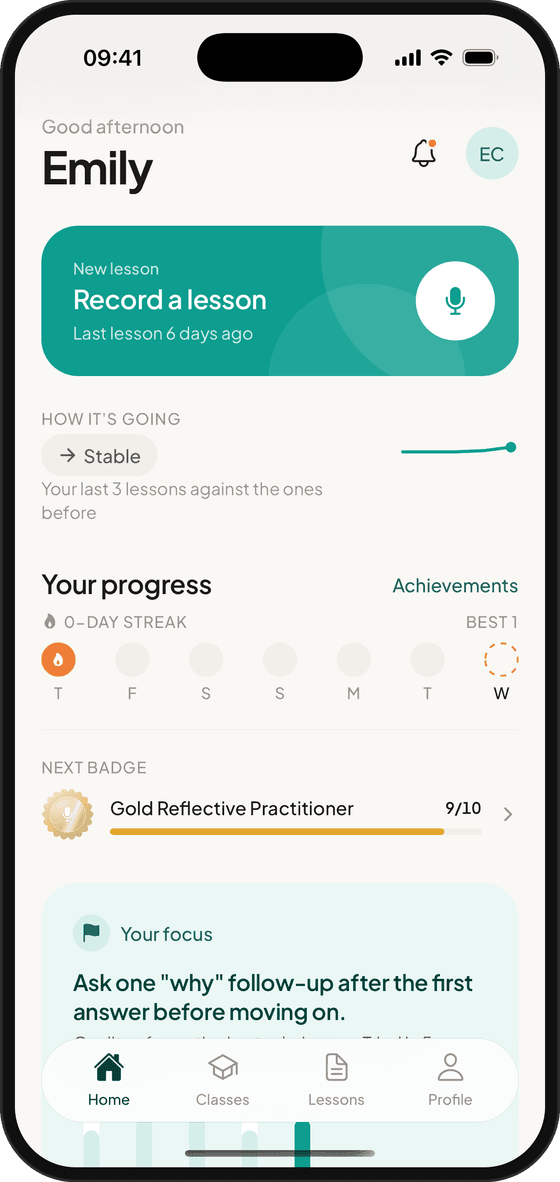
Used well, AI support looks quite different. It talks about the lesson that was actually taught, it arrives while the teacher still remembers that lesson, and it leaves the decisions about what matters and what to work on with the professional rather than the software. It also shouldn't create a single extra form or meeting. That's the standard we've tried to build EducAitor® to, and it's the standard I'd encourage any leader to hold other tools to.
A DfE survey found that 43% of teachers rated their confidence with AI at just three out of ten. I don't think more training on writing prompts will move that number very much. What will move it is teachers using tools that are clearly on their side, and seeing for themselves that their practice is improving as a result.
Sources
- DfE publishes guidance for use of AI in schools (UKAuthority, June 2025)
- Tes Teacher Wellbeing Report 2026: Global