
Brilliant at the trade, new to the classroom
Colleges rely on experts from industry, then leave them to work out teaching on their own. Support from the first week is what keeps them.


Picture a joiner with twenty years on site who decides to start teaching at their local college. They know the job better than anyone in the building, they can spot a badly cut joint from across the workshop, and their learners take them seriously because they've done the work for real. Then, on a wet Friday afternoon, they're standing in front of sixteen teenagers with no interest whatsoever in joinery, and nothing in those twenty years has prepared them for it.
Colleges and training providers are relying on more and more people like that, and with good reason. A National Audit Office report in 2025 found that general FE colleges had 5.1 vacancies for every 100 teaching roles, around 2,500 unfilled posts, and the DfE has estimated that between 8,400 and 12,400 FE teachers will be needed by 2028/29. NFER's 2026 report on the FE workforce also found that FE teachers' pay has fallen markedly compared with other groups, which makes it even harder to compete with what experienced tradespeople can earn in industry.
Recruiting them is the easy part
Bringing experts in from industry is the right answer, and learners benefit enormously from being taught by people who've actually done the job. But being outstanding at a trade and being able to teach it are two different skills, and the second has to be learned like any other. In fact, some of what makes someone excellent on site can get in the way. Experts do much of their work by instinct, and it's surprisingly hard to explain something you stopped thinking about years ago to someone who has never picked up the tools.
The problem is how little support many new teachers get while they're learning. Typically there's a short induction, a mentor who is also carrying a full timetable, and an observation at some point later in the year, by which time habits have formed and confidence may already have taken a knock.
Why support matters as much as pay
The DfE's evaluation of its FE retention payment, published in April 2026, found that 21% of teachers receiving it said they wouldn't have stayed in FE without it, and teachers who had come from industry were among the groups most likely to say so. The same evaluation found that workload was rated the least rewarding part of FE teaching, which is something no payment can fix. NFER points in a similar direction, suggesting retention could improve if FE teachers had more agency and better chances to progress. Money clearly matters, but people also leave because they're struggling and nobody has noticed, or because the only time anyone does notice is during a formal observation.
Support from the first week
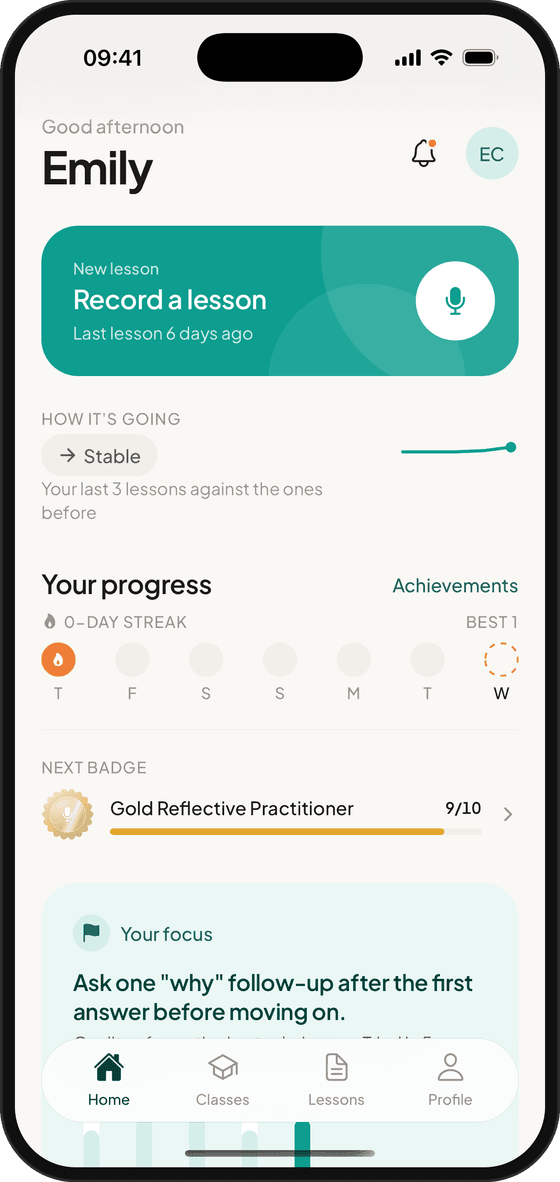
One of our partners, a training provider, uses EducAitor® with exactly this group: tutors who have come straight from industry without formal teacher training. Each of them gets feedback on their own sessions from their very first week, so they can see what's working and pick something to improve rather than waiting months for someone to tell them. Their leaders get an overview across the team, which means support can go where it's needed early, before a good tradesperson decides that teaching isn't for them.
The same is true well beyond colleges, for apprenticeship trainers, sports coaches, military and cadet instructors, careers advisers and anyone else hired for their expertise and then asked to teach it. If we want those people to stay, we have to help them become good teachers quickly rather than leaving them to work it out on their own.
Sources
- Teacher workforce: secondary and further education (National Audit Office, April 2025)
- The Further Education Teacher Workforce in England Annual Report 2026 (NFER)
- One in five FE teachers would have left without retention payment, DfE finds (FE News, April 2026)