
We know coaching works. So why do so few teachers get enough of it?
Coaching has one of the strongest effects in education research, and it falls apart at scale. The gap between the lesson and the feedback is why.


In my experience, if you ask teachers about the best professional development they've ever had, you'll rarely hear about a training day. Far more often it's a person: a mentor who watched them teach, noticed something they hadn't, and talked it through with them while the lesson was still fresh.
The research backs that up. In 2018, Matthew Kraft, David Blazar and Dylan Hogan brought together 60 studies of teacher coaching that used causal research designs. Across them, coaching improved teachers' instructional practice by 0.49 of a standard deviation and pupil achievement by 0.18, which is a substantial effect by the standards of education research. Much of the evidence came from literacy coaching in US early years and primary settings, so it isn't the last word on every phase, but the direction is clear.
The catch
The same paper found something that gets mentioned far less often. When coaching programmes were scaled up, the average effects from the larger programmes were only a fraction of those found in smaller, carefully run ones. Anyone who has tried to run coaching across a whole school or college will recognise why. Good coaches are rare and their time is expensive, so as soon as a programme grows, the observations get spread thinner, the follow-up conversations get shorter, and the gap between the lesson and the feedback gets longer.
Why that gap matters so much
The delay is more damaging than it looks. John Hattie and Helen Timperley's well-known review of the research on feedback frames it around three questions: where am I going, how am I going, and where to next? A teacher can only really answer the second and third if they can still remember the lesson in question. A week later, after another twenty lessons, they're relying on the observer's notes rather than their own memory, and the conversation becomes something that's done to them rather than something they're part of.
The Education Endowment Foundation's guidance on effective professional development, published in 2021, lists feedback as one of 14 mechanisms that make professional development work. It also points out that the impact of feedback varies, and that a lot depends on whether the person receiving it sees the source as credible. Feedback that turns up late and describes a lesson the teacher can barely recall struggles on both counts.
What technology can and can't do
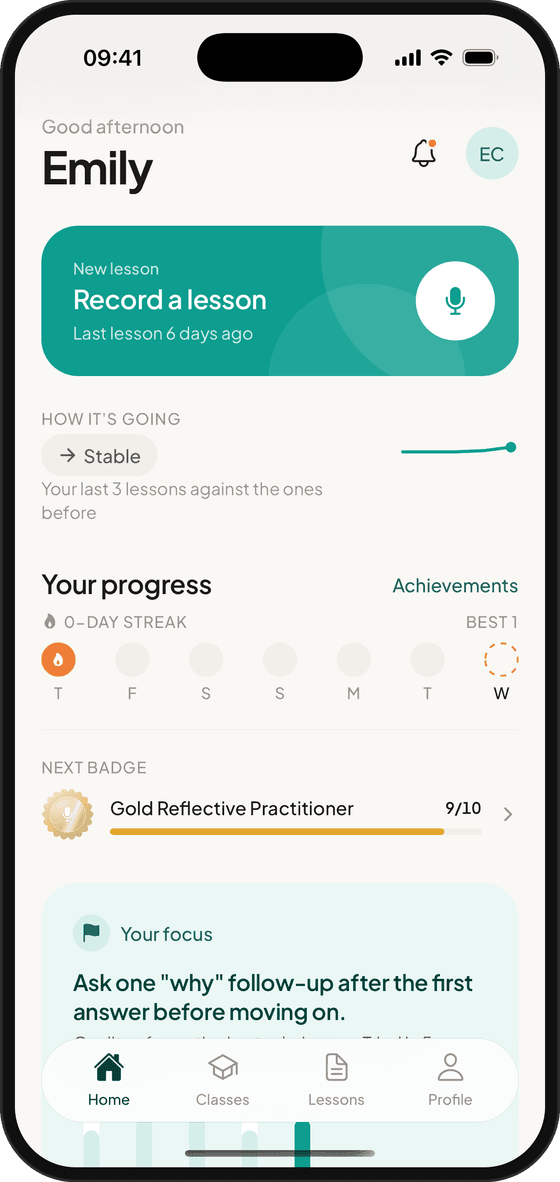
I don't think AI replaces a good coach, and I'd be wary of anyone who claims it does. What it can do is take on the part of coaching that doesn't scale, which is noticing what happened in every session and getting it back to the teacher quickly. EducAitor® gives educators feedback within about thirty seconds of a session ending, so the reflection happens while the lesson is still in their head, and then leaves it to them to decide what to work on next.
That also changes how a coach or mentor can spend their time. Instead of using their limited hours to sit in lessons and write up notes, they can put them into the conversation itself, with a teacher who has already thought about their own practice and arrives knowing what they want to talk about. That seems a far better use of some of the most valuable people in any school or college.
Sources
- Kraft, Blazar and Hogan (2018) The Effect of Teacher Coaching on Instruction and Achievement, Review of Educational Research, 88(4)
- Hattie, J. and Timperley, H. (2007) The Power of Feedback, Review of Educational Research, 77(1)
- Effective Professional Development guidance report (Education Endowment Foundation, 2021)